

What can a kingfisher’s beak teach us about high-speed train design?
How did the restoration of a single river valley spark a blueprint for future cities?
Why is "zero waste" not just a goal, but a fundamental law of every healthy ecosystem on Earth?
In this visionary and hands-on life science course, students explore the genius of nature to solve the biggest design challenges of the 21st century.
Meeting twice weekly in live online "Mission Controls," students step into the role of Systems Designers, examining how the natural world has spent billions of years perfecting energy, water, and community systems. Instead of memorizing isolated facts, students learn how cellular biology, ecology, and evolutionary adaptations provide the "Bio-Logic" for the sustainable technology of tomorrow.
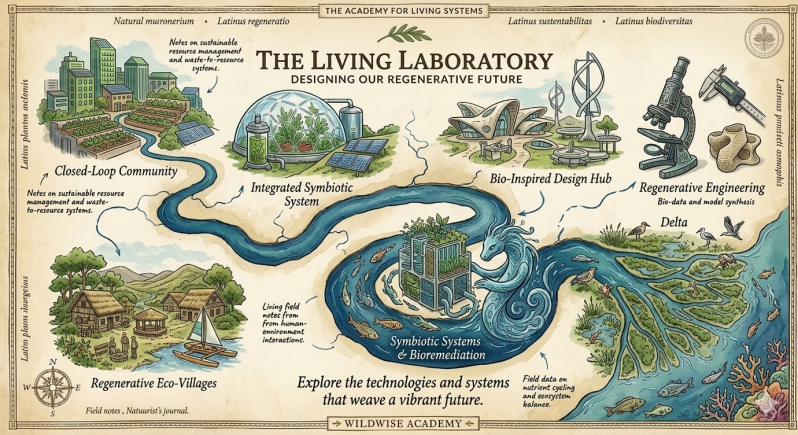
This course intentionally bridges the gap between the wild world and the human world. Students will dive deep into the "ghost history" of local river systems, the intricate architecture of termite mounds, and the microscopic marvels of plant cells to build a new vision for human settlement. We look at the "connective tissue" of our planet to understand how everything, from a single spore to a massive watershed, is linked.
Learning in this course is active and collaborative. Students participate in design sprints in our virtual Studio, conduct outdoor field observations in their own backyards, and work in "Design Guilds" to blueprint a high-tech, closed-loop ecovillage.
Throughout the year, we connect microbiology to large-scale engineering, exploring how mimicking nature’s patterns can help us combat climate change, restore biodiversity, and build resilient communities. By the end of the course, students will understand that sustainable design is not just a trend; it is an ecological and evolutionary necessity.
What Students Will Do
-
Investigate the "ghost history" of local river systems
-
Conduct outdoor bio-observation and field journaling
-
Analyze biological adaptations for engineering inspiration
-
Collaborate in "Design Guilds" to build 3D ecovillage models
-
Draft a "Charter for the Commons" to explore community ethics
-
Model closed-loop systems where waste becomes food
Course Format
-
Live online class twice per week
-
Weekly field work and nature observations
-
Collaborative design projects
-
3D Modeling (Minecraft Education or Tinkercad)
Certificate & Transcript Support
Students who complete the course will receive:
-
A Certificate of Regenerative Design
-
Final letter grade and competency-based assessment
-
Official course description and syllabus for homeschool transcripts
Transcript Categorization
This course is highly interdisciplinary and can be applied to several academic areas. Students may list this course under:
-
Life Science: (Ecology, Biology, Environmental Science)
-
Social Studies: (Environmental History, Human Geography, Urban Planning)
-
Technology & Engineering: (Sustainable Design, Biomimicry, 3D Modeling)
-
Electives: (Systems Thinking, Future Studies, Leadership & Collaboration)
(Parents should confirm requirements with their local homeschool regulations.)
Cost
$350 per semester
Includes:
-
Collaborative project guidance for Design Guilds
-
Instructor feedback on digital portfolios and 3D models