

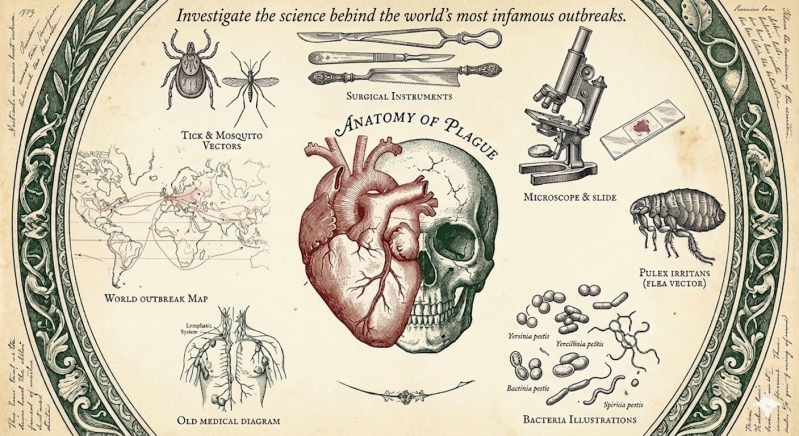
What can the Black Death teach us about ecosystems? How did one contaminated water pump change modern medicine? Why are antibiotic-resistant bacteria one of the biggest threats to global health today? In this fascinating and slightly macabre biology course, students explore biology through the lens of history’s most dramatic outbreaks.
Meeting twice weekly in a live online classroom, students step into the role of medical investigators, examining real historical cases and uncovering the biological mechanisms behind them. Instead of memorizing isolated facts, students learn how cellular biology, immunology, ecology, and evolution shape the spread of disease.
This course intentionally explores the grittier side of medical history. Students will encounter vivid historical accounts of early surgery, epidemic outbreaks, and the difficult scientific breakthroughs that changed medicine forever. Materials are presented in a scientific context, but professional maturity is expected.
Learning in this course is active and collaborative. Students participate in Socratic discussions in our virtual Operating Theater, conduct home-based biological investigations, and work in teams to investigate real disease systems.
By the end of the course, students will understand that disease is not just a medical issue, it's an ecological, evolutionary, and social phenomenon.
Course Format
-
Live online class twice per week
-
Weekly readings
-
Collaborative project work
-
At home hands-on labs
Syllabus
Introduction
- Background Knowledge: The Cell Under Attack
Unit 1: Medical Innovation and Failure
- Historical Surgical Practices; From Tradition to Science
- Germ Theory; Discovering the Invisible Cause of Disease
Unit 2: The Cell Under Attack
- Cell Structure • Pathogens
- Pathogens: Not All Invaders Are the Same
- Host–Pathogen Interactions
Unit 3: Evolution in Real Time
- Dengue Fever, Mosquitoes, and Systems Thinking
Unit 4: Ecosystems of Disease
- Zoonotic Disease Systems
- Biodiversity as Disease Protection
- Spillover Events
Unit 5: Epidemiology
- Detecting Disease Through Data
- Beyond Infectious Disease
- Environmental Exposures and Body Systems
- Understanding Health as an Interconnected System
Students who complete the course will receive:
- A Certificate of Completion
- Final letter grade
- Course description suitable for homeschool transcripts
This course qualifies as a high school biology lab science credit for homeschool programs. Parents should confirm requirements with their local homeschool regulations.
Cost
$350 per semester
A $100 non-refundable registration fee is required to secure your student's spot in the class. After registering, you will receive an email with instructions for paying the remaining balance. You may pay the full course price upfront or choose to pay per semester. All payments are due by the first class session.