

Rivers Tell Stories; Myth, Map & Earth Science
All classes will run through Google Classroom
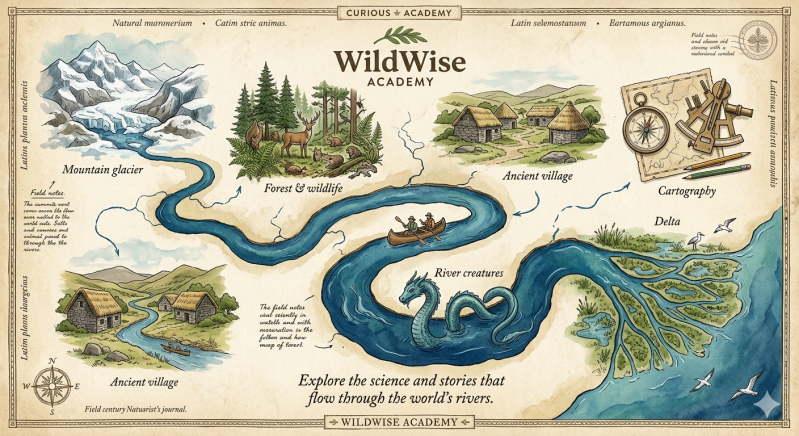
Rivers have shaped landscapes, ecosystems, and civilizations for thousands of years. They carve mountains, nourish forests, create fertile valleys, and inspire stories that pass from generation to generation. This immersive, interdisciplinary course explores rivers as both living systems and powerful storytellers. Students investigate how rivers are formed through geological processes while also exploring how cultures around the world understand and relate to rivers through story, tradition, and lived experience. Through mapping, hands-on investigations, storytelling, and project-based learning, students develop a deep understanding of their local watershed and the global importance of rivers.
Meeting once weekly in a live online classroom, students examine famous rivers around the world. Along the way, they'll uncover the science of watersheds, erosion, sediment transport, and ecosystems while also exploring the myths and cultural traditions that grew along these waterways. Students will work as river explorers, analyzing maps, studying landscapes, and tracing how rivers influence human settlement and culture. Learning is collaborative and inquiry-based. Students will work in small teams to research a river system, create maps, investigate its ecology, and explore the stories and traditions connected to it.
Course Format
-
Live online class once per week
-
Weekly readings
-
Collaborative and individual project work
Major Course Themes
- Rivers as Living Stories
Students explore how cultures around the world, especially Indigenous communities, understand rivers as more than physical features, but as living, meaningful parts of the landscape. - Mapping Our Place in the World
Learners develop spatial awareness by mapping their local watershed and tracing how water connects their home to larger ecosystems. - How Rivers Shape the Earth
Through hands-on investigations and models, students uncover the geological forces, like erosion and gravity, that form and continually reshape rivers. - Change Over Time
Students examine how rivers evolve across seasons and centuries, revealing the dynamic nature of Earth’s surface. - Rivers as Ecosystems
Students explore the rich biodiversity supported by rivers and the interconnected relationships between water, plants, animals, and people. - People and Rivers
Learners investigate how humans rely on, shape, and sometimes harm river systems - past and present. - Story, Art, and Expression
Through writing, art, and creative projects, students reflect on their personal and cultural connections to rivers. - Stewardship and Responsibility
Students think critically about water conservation and their role in protecting river systems locally and globally. - Inquiry, Observation, and Curiosity
Learners practice asking questions, analyzing patterns, and learning through direct observation and exploration. - Connection and Community
Students build connections - with each other, with place, and with the natural world.
Students who complete the course will receive:
- A Certificate of Completion
- Final letter grade
- Course description suitable for homeschool transcripts
This course qualifies for homeschool programs as one of the following:
- Earth Science
- Environmental Science
- Interdisciplinary Science
- Elective (Environmental Studies / Cultural Studies)
Parents should confirm requirements with their local homeschool regulations.
Cost
$275 per semester
A $100 non-refundable registration fee is required to secure your student's spot in the class. After registering, you will receive an email with instructions for paying the remaining balance. You may pay the full course price upfront or choose to pay per semester. All payments are due by the first class session.