

Rivers Tell Stories; Myth, Map & Earth Science
Middle School
All classes will run through Google Classroom
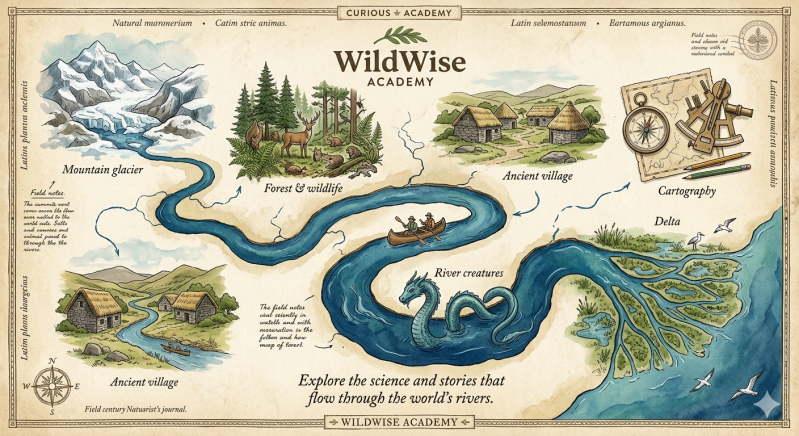
Rivers have shaped landscapes, ecosystems, and civilizations for thousands of years. They carve mountains, nourish forests, create fertile valleys, and inspire stories that pass from generation to generation.
In this interdisciplinary course, students explore rivers as both scientific systems and cultural storytellers. Through geography, earth science, mythology, and mapping, we investigate how water connects land, people, and history.
Meeting once weekly in a live online classroom, students examine famous rivers around the world. Along the way, we uncover the science of watersheds, erosion, sediment transport, and ecosystems while also exploring the myths and cultural traditions that grew along these waterways.
Students will work as river explorers, analyzing maps, studying landscapes, and tracing how rivers influence human settlement and culture.
Learning is collaborative and inquiry-based. Students work in small teams to research a river system, create maps, investigate its ecology, and explore the stories and traditions connected to it.
Hands-on projects help bring the science to life.
Students will:
-
build watershed models
-
map local waterways
-
investigate erosion and sediment movement
-
study aquatic ecosystems
-
explore mythology and storytelling traditions
By the end of the course, students will understand that rivers are more than water flowing across land - they are living systems that shape both earth’s landscapes and human imagination.
What Students Will Do
Students will:
-
investigate river ecosystems
-
explore myths and cultural stories connected to rivers
-
learn basic cartography and mapping skills
-
model watersheds and erosion processes
-
analyze how rivers shape civilizations
-
collaborate on a final river research project
Course Format
-
Live online class once per week
-
Map exploration and geography activities
-
Short weekly readings or videos
-
Collaborative river research project
-
Hands-on earth science investigations
-
Mythology and cultural storytelling connections
Assessment & Grading Policy
To foster a growth-oriented environment, this course utilizes a Feedback-First model.
-
Primary Evaluation: All assignments and assessments will receive comprehensive, qualitative feedback. This feedback is designed to highlight strengths and identify specific areas for improvement.
-
Grades by Request: If you would like a grade, you may request it at any time.
Cost
$295 per semester
Includes:
-
one live class per week
-
collaborative research project
-
mapping and science investigations
-
instructor feedback and guidance